Concrete specialists since 2012
Epoxy flooring in Sydney
We install solid colour, flake, metallic and polyaspartic floor coatings for garages, workshops, commercial spaces and warehouses. Because we're concrete grinders first, the preparation that decides whether a coating lasts is done in-house, not rushed.
| Solid colour epoxy | $40 to $70 /m² |
|---|---|
| Flake system | $70 to $120 /m² |
| Metallic epoxy | $100 to $160 /m² |
| Polyaspartic | $90 to $160 /m² |
Typical Australian market ranges for 2026, including standard preparation. A guide, not a quote.
Get your free quote
Tell us the space, the size and the look you're after. We reply within one business day.
What epoxy flooring is
Epoxy flooring is a resin coating made from two parts, a resin and a hardener, mixed on site. Once mixed it cures by chemical reaction into a hard, glossy plastic layer that bonds to the concrete. It doesn't soak in like a sealer. It sits on top as a continuous skin that resists oil, chemicals, impact and wear.
Coatings come in different builds. A thin roll-on coating suits light-duty garages and storage areas. A high-build system, laid thicker in several coats, takes heavier wear in workshops and commercial floors. Self-levelling epoxy is poured and spread to a smooth, thick layer, which is how metallic floors and many industrial floors are done.
The "epoxy" sold in hardware store garage kits is usually a thin, often water-based epoxy paint. It can freshen up a garage, but it isn't the same thing as a professional system laid at proper thickness on a ground slab, and it won't last like one. If you're comparing paint with epoxy for a garage, that difference in film thickness and preparation is most of the answer.
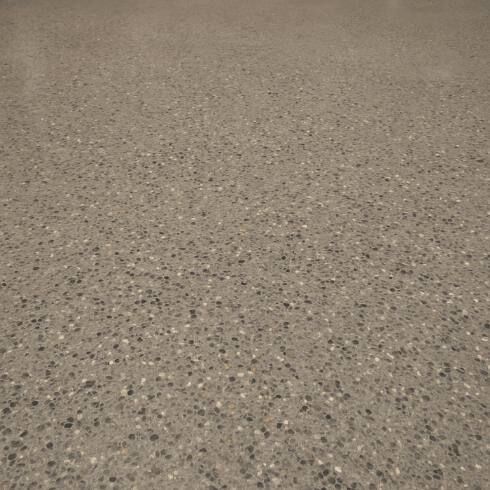
Preparation is most of the job
When an epoxy floor peels, the coating is rarely to blame. Almost every failure traces back to the concrete underneath: a smooth, weak top layer that wasn't removed, oil or old sealer left in the surface, or moisture coming up through the slab and pushing the coating off from below.
Proper preparation starts with a moisture check, because a damp slab needs a moisture-tolerant primer or more drying time. The slab is then diamond ground to remove the weak surface and create the profile the primer needs. Standard epoxy primers usually call for a profile around CSP 2 to 3 on the industry scale. Cracks and joints are repaired so they don't telegraph through, and the floor is vacuumed clean before anything is mixed.
Grinding is what we do every day, so it's done properly on every coating job. Our concrete grinding page explains surface preparation in more detail, including removing old coatings before a new system goes down.
Systems and finishes
We install four main systems. The right one depends on how the floor is used, how much sun reaches it, how quickly you need it back, and the look you want.
| System | Looks like | Best for | Keep in mind |
|---|---|---|---|
| Solid colour epoxy | One even colour, usually gloss | Workshops, warehouses, plant rooms, budget garages | Shows dust, scratches and tyre marks more than flake |
| Flake system | Coloured vinyl flakes broadcast into the coating, sealed under a clear topcoat | Garages, shops, offices and change rooms | The most forgiving look for hiding dirt and wear, with grip from the texture |
| Metallic epoxy | Swirled, pearlescent patterns that look like stone or flowing liquid | Showrooms, salons, feature garages and retail | Each floor is one-off, and it shows scratches more than flake |
| Polyaspartic | Clear or coloured coating, often over flake | Garages in sun, floors needed back quickly | UV-stable and fast curing, at a higher price |
Any system can be made more slip resistant by adding grit to the final coat. It's worth doing on ramps, wet areas, commercial entries and anywhere oil gets onto the floor.
Epoxy garage floors
Garages are the most common epoxy job. A coated garage floor stops oil and brake fluid staining the concrete, sweeps and mops clean, and turns a dusty slab into usable space for a gym, workshop or storage.
Flake systems are the most popular choice because they hide dirt, tyre marks and small scratches well, and the flakes add texture underfoot. Two things matter more in a garage than anywhere else in the house. The first is hot tyres: after a drive, tyres can be hot enough to soften a weak coating and pull it off the slab, which is why preparation and a quality system matter. The second is sunlight: standard epoxy yellows in direct sun, so where afternoon light pours in through an open roller door, a UV-stable polyaspartic topcoat holds its colour far better.
If you mainly want a clean, sealed slab rather than a coloured floor, compare grind and seal for garages, which keeps the concrete look and usually costs less.
Commercial and warehouse epoxy flooring
Warehouses, factories, workshops, showrooms and shops use epoxy because it has no joints or grout lines, cleans easily and resists the oils, fuels and chemicals that soak into bare concrete. On a warehouse floor, a high-build or self-levelling system handles forklift and pallet jack traffic, and line marking for walkways, bays and exclusion zones can be built into the coating.
Slip resistance matters on commercial floors, especially at entries and anywhere liquids end up on the floor. In Australia, slip resistance is rated under AS 4586 for new surfaces and AS 4663 for existing ones, and our polished concrete page explains how those ratings work. Anti-slip grit in the topcoat lifts the rating, and an independent test can confirm it if your certifier asks.
Downtime is usually the other big question. Epoxy needs days to reach full strength, so commercial floors are often done in sections, after hours or over a weekend. Where the floor needs to be back in use quickly, polyaspartic coatings cure much faster. Food preparation and wet areas usually have extra hygiene and drainage requirements, so tell us how the space is used and we'll specify a system to suit.
Epoxy vs polished concrete vs grind and seal
We install all three, so we've no reason to push one. Here's how they compare.
| Epoxy | Polished concrete | Grind and seal | |
|---|---|---|---|
| Look | Any colour, flake or metallic. Hides the concrete | The concrete itself, from matte to high gloss | The concrete under a clear or tinted sealer |
| Chemical and oil resistance | Very good | Moderate. Acids can etch it | Moderate, depends on sealer |
| Upkeep | Recoat the topcoat when worn | Occasional re-burnish | Reseal every few years |
| Typical cost | $40 to $160 per m² | $80 to $220 per m² | $45 to $80 per m² |
| Best for | Garages, workshops, warehouses, commercial | Homes, retail and offices | Garages, alfresco, rentals, tight budgets |
For a full price breakdown on the concrete finishes, see our polished concrete cost guide.
What epoxy flooring costs
The system you choose sets the base price. Solid colour is the cheapest, flake sits in the middle, and metallic and polyaspartic cost the most. On top of that, the condition of the slab matters a lot. Old coatings to remove, oil-soaked concrete, cracks, and moisture that needs a special primer can all add as much as the coating itself.
Size works in your favour. Grinding, setup and edge work are partly fixed, so a double garage costs noticeably less per square metre than a single. When comparing quotes, check whether grinding is included, how many coats are applied, and what topcoat goes on.
Double garage, flake, about 36 m²$2,500 to $4,500
Workshop, solid colour, 80 m²$3,200 to $5,600
Metallic feature floor, 30 m²$3,000 to $4,800
Typical Australian market ranges for 2026. Heavy coating removal and moisture treatment are extra. Your fixed price comes after a free measure.
Get my exact priceCan epoxy flooring be used outside?
Standard epoxy isn't a good outdoor finish. Sunlight breaks it down, so it yellows, chalks and loses its gloss. Outdoor slabs also move more with heat and moisture, which a rigid coating doesn't like.
For areas that get some sun, such as a garage floor near the roller door or a covered entry, a UV-stable polyaspartic topcoat over the system is the usual answer. For fully outdoor concrete like driveways, alfresco areas and pool surrounds, a sealer is usually the better choice. Our concrete sealing page covers outdoor options.
DIY kits or a professional system
Garage epoxy kits are popular, and on a clean, dry, sound slab they can give a decent short-term result. Where they fall down is the preparation and the build. Most kits rely on etching instead of grinding, so the coating grips poorly, and they go on as a thin coat that wears through quickly in tyre paths.
Two-part epoxy also has a limited working time once mixed, so a large floor needs planning and more than one pair of hands. If you try it yourself, grind the slab, check it's dry, and keep the coats even. If the floor matters to you, a professional system laid at proper thickness will outlast several kits.
Looking after an epoxy floor
Sweep or dust mop regularly, because grit carried in on tyres and shoes is what scratches and dulls a coating over time. Mop with warm water and a mild, pH-neutral cleaner, and avoid harsh acidic or citrus cleaners and soap-heavy products that leave a slippery film.
Epoxy is hard but not scratch-proof. Dragging steel equipment, dropping tools and sliding furniture without pads will mark it, and flake systems hide this better than solid colour or metallic. Put mats under workbenches and protect the floor when moving heavy items. When the topcoat eventually wears in busy paths, it can be lightly sanded and recoated without redoing the whole system.
Epoxy flooring FAQs
How soon can I drive on a new epoxy floor?
For a standard epoxy system, plan on light foot traffic after about 12 to 24 hours and cars after at least 72 hours. Epoxy keeps hardening for around a week, so waiting longer before parking is safer, especially in cool weather. Polyaspartic coatings cure much faster and can usually take foot traffic within hours and cars after about a day.
How long does an epoxy floor last?
A professionally installed system on a properly prepared slab lasts many years in a home garage. The topcoat is the part that wears, and recoating it when traffic paths dull keeps the floor going. Heavy commercial and warehouse floors wear faster and are recoated more often. Poor preparation is the main reason floors fail early.
Is epoxy flooring slippery?
A smooth gloss epoxy can be slippery when wet or oily. Flake floors have more texture, and anti-slip grit can be added to the topcoat of any system. We recommend it for ramps, entries, wet areas and commercial floors.
Is epoxy flooring good for homes?
It suits garages, laundries, home gyms, workshops and basements well. For living areas, most people prefer the warmer look of polished concrete, although metallic epoxy is sometimes used as a feature floor. Epoxy also yellows in direct sun unless it has a UV-stable topcoat.
Can epoxy go over an existing coating or sealer?
Usually not. A new coating is only as strong as what it's stuck to, so old paint, sealers and failing coatings are ground off first. A sound epoxy floor in good condition can sometimes be sanded and recoated, which we'll check at the measure.
Related concrete services
Get the right coating for your floor
Book a free measure. We'll check the slab, test for moisture and recommend a system that suits how you use the space.